
I landed in New York in October of 2020, in personal protective equipment (PPE), a few hours after celebrating my father’s birthday back home in Delhi, with no idea of when I would see my parents again. If at all. I was moving continents the moment the travel ban lifted. The narrow window allowed students, scholars, and stranded families to move between the United States and India, an outcome of diplomatic coordination that many of my classmates and colleagues never benefited from.
I was on my way to continue an Executive Master’s degree in Public Administration at Columbia University in New York, a city that had buried more than 2,000 people that spring. The hospitals on the Upper East Side had largely emptied out by then. Elmhurst, in Queens, had not recovered, and would not for a long time. I was studying American public administration formally in a classroom while watching it operate informally a few blocks away in church basements, repurposed stadiums, and tenant associations. They had been doing crisis response since long before the pandemic gave the field a name.
That gap between the formal and the informal is where I have spent most of my career: first in India, then the Netherlands, then advising government ministries on urban resilience, and now running a clean energy program working within the limits of what Indian state infrastructure can actually deliver. In each of these settings, the question that determines whether a resilience program works has rarely been about the quality of the technical design. It has been about whose existing knowledge the design is built on—and whether the people who hold that knowledge are credited and funded or simply consulted once and then folded quietly into someone else’s report.
I have watched New York up close, as both an international student and as a New York resident. Figuring out the balance between the emotional toll of being far from family amid the pandemic, the uncertainty of work permits, and the cost of shoe-box-sized apartments on the Upper West Side, taught me to see something I had been circling for years. In the United States, the institutions that receive credit for building climate resilience are very often not the institutions that built it. The credit arrives late, attached to another name, after the underlying work has already been tested by years of practice in the neighborhoods that needed it most.
WE ACT
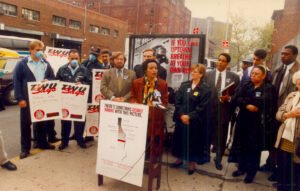
In 1988, after years of breathing the unfiltered stench of a sewage treatment plant that had been routed to West Harlem once wealthier neighborhoods downtown rejected it, Peggy Shepard, Chuck Sutton, and Vernice Miller-Travis founded West Harlem Environmental Action, known today as WE ACT for Environmental Justice.
None of that record-keeping was commissioned by the state of California. It was built by people picking grapes.
The neighborhood had already hosted a sewage plant, a marine transfer station, and six of Manhattan’s bus depots, and its founders were not waiting for the city’s Department of Environmental Protection to discover the concept of cumulative pollution. The founders built the documentation, the litigation strategy, and the community health partnerships themselves, often with no funding beyond what they could raise from their own networks.
WE ACT became one of the first environmental justice organizations in the country founded by people of color. It carried out this work for the better part of four decades before the federal Environmental Protection Agency, under the 2022 Inflation Reduction Act, selected it to run a federally funded technical assistance center. That center now helps other communities access the same category of investment that organizations like WE ACT had spent decades arguing into existence.
A Landfill, a Protest, a Federal Report
To understand how the pattern of government following community organizations became national, it helps to go back further to 1978, in Warren County, NC, four years before the term “environmental justice” existed in anything close to its current usage. A trucking company hired to dispose of soil contaminated with polychlorinated biphenyls, industrial chemicals known as PCBs, instead drove the roads of 14 counties at night and dumped the waste along 240 miles of road shoulder to avoid the cost of proper disposal.
When the state of North Carolina finally moved to clean up the contamination, it chose to build the new landfill in Warren County, the poorest county in the state and primarily Black. Residents fought the decision for four years through every available channel, with limited success. In September 1982, when the disposal trucks finally arrived, residents and supporters lay down in the road to block them. Six weeks of nonviolent protest followed, and more than 500 people were arrested, the first arrests in American history over the siting of a hazardous waste facility.
The protest did not stop the landfill from being built. What it produced instead was a reckoning that no federal agency had volunteered to undertake on its own initiative. A North Carolina Congressman asked the US Government Accountability Office, then known as the General Accounting Office, to study whether hazardous waste sites across the South were disproportionately located in minority communities. The answer was yes.
Five years later, the United Church of Christ’s Commission for Racial Justice expanded that inquiry into a national study, published as Toxic Wastes and Race in 1987. The data held up at scale: race, more consistently than income, was the strongest predictor of where the country put its most dangerous waste.
The EPA did not yet have an environmental justice office, or even a settled environmental justice concept, when that report came out. The residents of Warren County had effectively built both for the agency, years ahead of any office in Washington formally taking up the question.
Social Infrastructure
The same dynamic showed up in a climate disaster that had nothing to do with toxic waste. In July 1995, a heat wave settled over Chicago for five consecutive days. Temperatures reached 106 degrees Fahrenheit, with a heat index near 120. By the time the heat broke, hundreds of people were dead, more than died in the Great Chicago Fire of 1871. The sociologist Eric Klinenberg spent years afterward trying to understand why the deaths fell where they did, and the pattern he found revealed that poverty alone determined who lived and who died.
Every country I have worked in eventually has to answer the question of whether it will fund the people who already hold local knowledge.
Two South Side neighborhoods, Englewood and Auburn Gresham, looked nearly identical on paper: both close to 99 percent Black, both with high poverty rates, both with comparable shares of elderly residents living alone. Yet Englewood’s heat-related death rate was 33 per 100,000 residents, while Auburn Gresham’s was three per 100,000, lower than many of the wealthiest neighborhoods on Chicago’s North Side.
Klinenberg’s explanation was what he called social infrastructure: the diners, churches, and block clubs that had survived in Auburn Gresham and had largely disappeared from Englewood, which lost roughly half its population and most of its commercial corridor between 1960 and 1990.
None of the institutions that kept Auburn Gresham’s residents alive had been built or funded as climate adaptation. A senior lunch program was not commissioned to lower a neighborhood’s heat mortality rate. But it did exactly that, years before any US city had an official heat emergency plan.
Sign up for our free newsletters
Subscribe to NPQ's newsletters to have our top stories delivered directly to your inbox.
By signing up, you agree to our privacy policy and terms of use, and to receive messages from NPQ and our partners.
A Union Built a Pesticide Record
California’s Central Valley tells a parallel story from an entirely different sector of organizing. The United Farm Workers’ campaigns of the 1960s, led by César Chávez and Dolores Huerta, began as fights over wages, working conditions, and union recognition for farm laborers, most of them Mexican and Filipino immigrants picking grapes and lettuce under brutal conditions.
Almost as a byproduct of that organizing, the union produced the first sustained documentation in the country of agricultural pesticide exposure among the people most directly affected. Neither Chavez nor the organizers around him were credentialed environmental health researchers. They were simply organizing people whose bodies were registering chemical exposure that no state agency at the time was systematically monitoring.
Over decades, worker testimony and union record-keeping became part of the evidentiary foundation for the pesticide reentry intervals and farmworker protection standards. California’s regulators would eventually formalize these standards, long after the union first raised the alarm.
The union’s most visible tool for forcing that record into public view was the consumer boycott, organized first against table grapes in 1965 and later extended to lettuce. The boycott asked ordinary Americans across the country to stop buying a product until the people who picked it had safer conditions and a union contract.
The boycott took years to win, and it succeeded in part because the union had already done the work of building a verifiable account of harm, illness, and exposure that consumers and journalists could check. None of that record-keeping was commissioned by the state of California. It was built by people picking grapes in 100-degree heat who had every reason to expect that nobody outside their own community would ever take it seriously.
Implementation Partners and Originators
By the time federal climate adaptation policy matured into something with meaningful budgets behind it, the underlying architecture had already been field-tested for decades by the very organizations now positioned as implementation partners rather than originators.
That distinction matters. Implementation partners receive contracts and program funding. Originators receive credit for having built something in the first place, and credit of that kind shapes who gets invited into the next round of decisions, who gets cited in the next policy document, and whose name attaches to the idea going forward.
By the time formal city services caught up, the informal networks had already been running, on their own resources, for weeks.
American philanthropy and the US government have grown reasonably comfortable funding the former. They remain considerably more reluctant to formally name the latter, in part because doing so would mean acknowledging that the formal sector spent a long stretch of time studying a problem that community organizations had already solved at the neighborhood level.
I have spent enough years inside multilateral and national government resilience planning, across India and international institutions, to know that this particular dynamic is not unique to the United States. Every country I have worked in eventually has to answer the question of whether it will fund the people who already hold local knowledge, or commission a new study to rediscover what they already know.
But the pattern is unusually visible in the United States, a country with deep institutional capacity that has nonetheless tended, again and again, to commission the fresh study rather than fund and credit the tenant association, the union, or the church network already holding the knowledge in question.
New York, for all its bureaucratic density and the genuine competence of its public health institutions, ran on exactly this logic during the spring of 2020. The block associations, universities, student groups, and mutual aid networks organizing food and medicine deliveries were not waiting for the city’s emergency management apparatus to reach them first. By the time formal city services caught up, the informal networks had already been running, on their own resources, for weeks.
What the 250th Is an Occasion to Mark
There is a version of America’s 250th that reaches for the most familiar material available: founding documents, the formal architecture of federal and state government, as though that architecture were the whole story of the country’s resilience.
That version is not inaccurate so much as incomplete. It leaves out the neighborhoods, Harlem, Chicago’s South Side, California’s Central Valley, that did not wait for the formal architecture to arrive before building something that worked, using whatever resources their own communities could pull together. Warren County, WE ACT, Auburn Gresham, and the United Farm Workers are not stories about government failure, and I want to be careful not to let them read that way. That is not the argument I am making as someone who has spent a career studying state capacity from the outside and who has real respect for what functioning public institutions can do.
These are instead stories about a specific and recognizably US habit: communities building the institution they need in the moment the one that is supposed to exist has not yet shown up, then carrying that institution forward long enough for the government to eventually catch up and formalize what already worked.
That habit is a form of practical ingenuity, and it is worth naming plainly as part of what the country’s climate resilience is actually built on, rather than treating it as a footnote to the government’s own account of itself. It is also a habit worth remembering precisely because it is reproducible. None of the four examples here required a federal mandate, a foundation grant of any real size, or a planning department’s permission to begin.
They required people willing to keep a record, organize their neighbors, and stay with the problem long after the news cameras and the state inspectors had moved on. That is a more demanding form of infrastructure than concrete or wiring, because it must be renewed by every generation that inherits it.
The US nonprofit and civic sector did not simply adapt to climate vulnerability after the fact. In the places that mattered most, across four decades and entirely different kinds of crises, it built the resilience first, named it last—and in many cases is still waiting for the public record and the funding to catch up. A 250th anniversary is as good an occasion as any to make that correction, not as an indictment of the country, but as a more accurate account of how it built the parts of itself that have kept people alive.