
Nonprofit Quarterly (NPQ) has partnered with Counterstream Media to co-publish Peace & Riot’s latest issue—a collection of more than 20 voices exploring climate leadership on the frontlines, in communities, and in the culture. Read the full Peace & Riot issue here.
Oʻahu is an island of lava and water. Neither can exist without the other. The land’s riches have attracted people for centuries; in fact, it was the first of the Hawaiian islands that colonizers set their eyes on in the 18th century. These days, it’s home to the state’s largest number of Native Hawaiians outside the mainland. These are their ancestral lands—lifeways that foreigners continue to desecrate.
Five years ago, the U.S. military contaminated the island’s waterways when underground storage tanks spilled over 180,000 gallons of toxic petroleum into the groundwater. People got sick and rose up to demand accountability. After public pressure, the U.S. government shut down the facility and removed most of the fuel from the site. In June, the U.S. Department of Justice finally reached a $17 million settlement with 3,600 people.
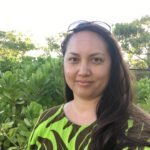
Mai Hall, a Native Hawaiian and military spouse whose family got sick from the water, is relieved to receive some material support to manage her children’s lifelong impacts—but money can never repair the harm to the land. Hall has been on the frontlines of fighting for her people and their water. Without her community’s voice, who knows where the crisis would be today.
Their efforts, however, are not over. Since the U.S. settler colonial project began 250 years ago, Indigenous lifeways have fissured, but resistance to empire is growing. As Hall says, “They took the land, they poisoned our water, and they’re not facing the consequences of their actions.” It’s past time that the U.S. government does. The water deserves more—in Hawai’i and beyond.
This interview has been lightly condensed and edited for clarity.
Yessenia Funes: I wanted to first ask you if you could ground us in where you are and describe the lands that helped shape you and your advocacy.
Mai Hall: What I’m hearing is a ho’olauna, or an introduction.
ʻO wau o Mai Kapuaoʻihilani Mei Lin. Noho au i ʻĀliapaʻakai, aka, hanau ʻia o Kalihi, ma kona o Oʻahu, ma Hawaiʻi. Which means aloha, my name is Mai, and I live in Salt Lake, which is called ʻĀliapaʻakai, but I was actually born in the ahupuaʻa of Kalihi in the district of Kona, on the island of Oʻahu.
I am Native Hawaiian by birth. And to us Hawaiians, where we come from is very important. The ahupuaʻa, or the land division where we were born, helps to shape our identity and who we are. So telling people the ahupuaʻa where we’re from is very innate within us. We know the sands of our birth, or our kuʻu one hānau. And that place where we come from has its own winds and rains that fall upon the ʻāina, the land that nurtures us. We work on the land, the ʻāina that nurtures us, and we raise food from the land, which in turn nourishes our bodies.
We have this saying in Hawaiian, ʻōlelo noʻeau: he aliʻi ka ʻāina, he kauwā ke kanaka. The land is the chief, the man is its servant. We have this very reciprocal relationship with the land, very humble, gentle, well-regarded.
Yessenia Funes: How did the reciprocal relationship that you share with the land, with the ‘āina, lead you to the Red Hill fight as a water protector?
Mai Hall: The Red Hill fuel spill happened in November of 2021. The fuel tanks started leaking decades ago, but nobody really knew. What we do know from this recent case is that 19,000 gallons of jet fuel started leaking from these old tanks that were sitting just 100 feet above a freshwater aquifer and sickened nearly 100,000 people.
The spill mostly affected the thousands of people who lived in housing that was linked to the Navy. The military has its own water line and its own tanks to store the water. And in this way, the military poisoned its own people. They knew that the water was tainted, and they knowingly poisoned their own people.
“I’m a Hawaiian first, and I’m going to do what I’ve always done and protect Hawaiian land rights, the environment, and my people, my lāhui.”
My husband is an active duty Air Force. He joined later in life. We already had a family, our children, and then he decided to join the military. So I walk this very thin line being a Kanaka Maoli, a Hawaiian, and a military spouse. And that line gets blurred the more I protest the military and protect sacred lands for Hawaiʻi. I told my husband I didn’t want him to join. But when he did join, I told him, I’m a Hawaiian first, and I’m going to do what I’ve always done and protect Hawaiian land rights, the environment, and my people, my lāhui.
Yessenia Funes: I imagine there must be a lot of tension between wanting to protect your land and culture, but also wanting to support your husband. How do you balance those tensions? Especially because it’s a line that many people have to figure out how to hold.
Mai Hall: The tensions in our dynamic stem from a much longer history.
The relationship between Native Hawaiians and the military is rooted in centuries of colonization and, in particular, the illegal annexation of Hawaiʻi. In 1893, the so-called “Committee of Safety”—a group of sugar businessmen and descendants of missionaries—conspired with American warships to stage a coup. They pointed their warships directly at the Hawaii State Capitol from the harbor and threatened our Queen Liliʻuokalani to sign over the Kingdom of Hawaiʻi to America or else we will shoot you and kill the Hawaiian people. The loss of life would’ve been immeasurable. We didn’t have many guns.
We were recognized as the Native Hawaiian Kingdom, as an independent sovereign nation. So to have America come in and say, We want to own your kingdom, our Queen was like, What, for real? You’re threatening me? No, no, no, we’ll make this happen diplomatically. Because that is the nature of our Queen. That was her ʻano. She knew that America—that this was just a small group of people doing a very hewa thing, a very wrong thing. She thought that America would right that wrong and make it pono again. Pono is our word for righting wrongs, for letting justice prevail. She thought it would be pono if she wrote a letter to the current president saying, look what your white guys are doing on our land. They’re acting awful. How about you fix whatever they’re doing? She thought the President would do the right thing, but then McKinley got elected president and the Spanish-American War happened, and he needed a military base in the middle of the Pacific.
All to say, a lot of things happening in America during the 1890s triggered the overthrow and the annexation of Hawai’i—which never got ratified by Congress, by the way. Which is why we Hawaiians say it is an illegal annexation. Because it is illegal. It never got held up by Congress, never got signed. They imprisoned our queen. Our queen kept fighting for independence, saying, what America did was wrong, but Hawaiians, don’t give up hope. Someone will fix this. Nobody ever fixed it. So that’s why so many Native Hawaiians do not trust America.
Because of what happened, our land got taken away, our language almost died. My grandmother was beaten in school for speaking Hawaiian. So she told all her children, don’t speak Hawaiian, don’t marry Hawaiian. They’re pīlau, they’re dirty. There’s a lot of historical trauma that our people have had to deal with just to survive the genocide of our culture by America.
Yessenia Funes: How do you hold that history, that trauma, alongside the love and support for the folks in your life, whether that’s your husband, friends, family members, who are still serving in the military?
Mai Hall: I have a lot of family members who serve in the military. There was one point in fact when the proportion of Native Hawaiians serving in the military was one of the highest proportions of any other ethnicity by race.
When that data was first published, a lot of Hawaiians were like, I thought you guys never liked America. Why are you serving in the U.S. military? I had those same questions growing up. I would ask my auntie, Auntie, why are you serving in the military? Cousin, why are you joining? I didn’t understand.
“So when I protest the military, when I show up holding signs, I’m not trying to be anti-American. I’m just saying I am a Kanaka living in this land, and I support my Hawaiian kingdom.”
But I get it now as a military spouse. There’s a sense of service before self that is within military culture. And the family I’ve talked to has always said, I can be a Native Hawaiian, and I can still serve in the American military because I am not anti-American. I’m just pro-Hawaiian. So when I protest the military, when I show up holding signs, I’m not trying to be anti-American. I’m just saying I am a Kanaka living in this land, and I support my Hawaiian kingdom. And yet I can still show aloha and love toward the military. I can still hope that they do the right thing, that they become good people, that we can raise our children and take care of our land together on this land.
Yessenia Funes: This message—I’m not anti-American, I am pro-Hawaiian—resonates so deeply. For me, hearing you say that as a child of immigrants, it made me think, I’m not anti-American, I’m just pro-immigrant, right?
This issue of Counterstream is focused on 250 years of the empire’s existence, and the Red Hill water crisis is one part of that long legacy of American settler colonialism. What does resistance look like given America’s ongoing occupation?
Sign up for our free newsletters
Subscribe to NPQ's newsletters to have our top stories delivered directly to your inbox.
By signing up, you agree to our privacy policy and terms of use, and to receive messages from NPQ and our partners.
Mai Hall: Resistance in the face of occupation means learning my language, continuing to learn ʻŌlelo Hawaiʻi. It means taking my children to loʻi, kalo fields, so they can put their feet in the mud, in the dirt, in our ʻāina, and work the field and sweat under the Hawaiian sun and plant our ancestors’ food that has been growing for centuries in our land. It means feeling the lepo, mud, between your fingers and working in the ʻāina. That is what resistance looks like. Sorry, I didn’t think I would be this emotional.
Yessenia Funes: Take your time.
Mai Hall: It means keeping our traditions alive in the face of land loss. I don’t own my own house. I’m in my 40s, and I do not own property in my homeland. My mother just turned 71 years old, and she still does not own a home. She’s on this Native Hawaiian list, a homestead list, to get a piece of property—and she’s still waiting for her turn to have a piece of land in Hawaiʻi.
Resistance is hoping that we can own land in our own homeland someday. Resistance is continuing to try.
Yessenia Funes: You describe resistance as reconnection with cultural traditions, with ancestral lifeways. How do you see the Red Hill water crisis and specifically the victories y’all have had in terms of getting the facility shut down—how do you see this effort as part of that journey of making resistance really come to life?
Mai Hall: Water, wai, is an important topic to Hawaiians. Wai is connected to our ancient akua, our gods. So because water is a gift from our gods, it is precious to us. Water brings life.
“When the heavens weep, the earth grows. We see rain as a source of life. We see our freshwater streams, our aquifers, as our source of life-bringing ola, life. When the military poisoned it and made us sick, it was such a foreign concept to us.”
We also have this ʻōlelo noʻeau that says Uē ka lani, ola ka honua. When the heavens weep, the earth grows. We see rain as a source of life. We see our freshwater streams, our aquifers, as our source of life-bringing ola, life. When the military poisoned it and made us sick, it was such a foreign concept to us.
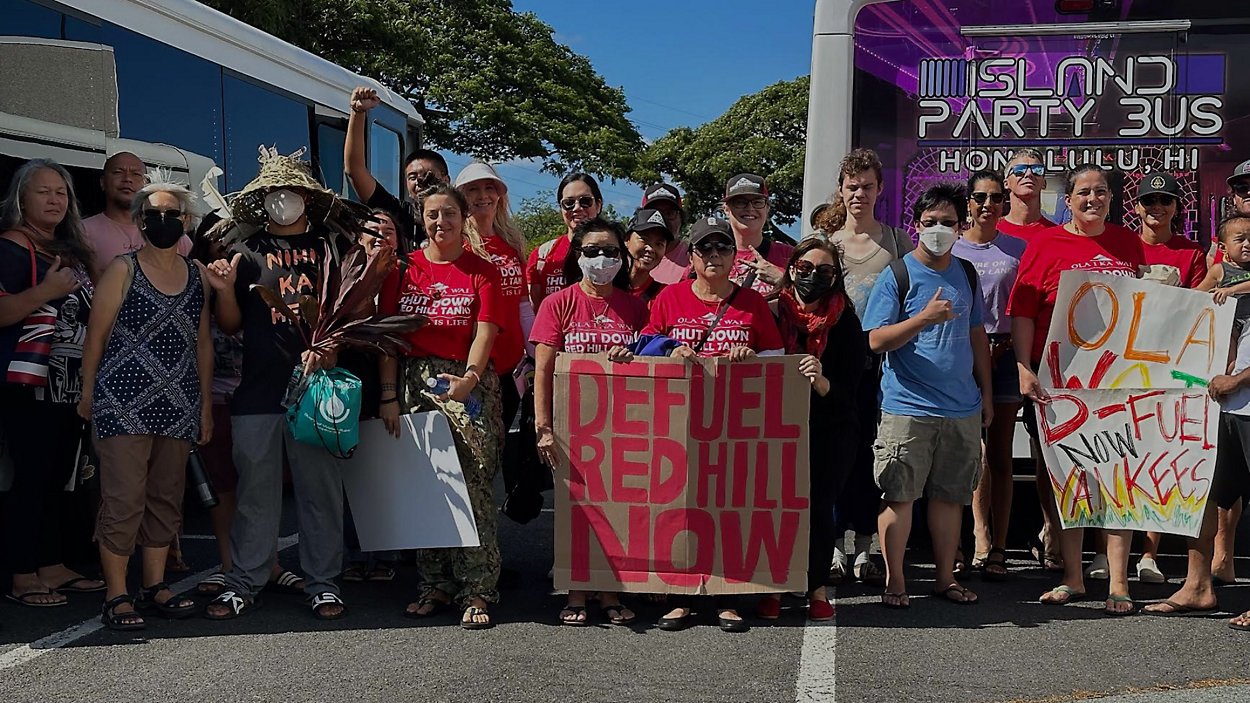
Red Hill traumatized thousands of us because we were told not to trust the water coming out of our tap. So of course we had to fight to fix this wrong. We gathered, we mobilized communities and got locals—Natives and non-Natives alike—to show up to hearings.
We did a lot of Western practices. We crafted legislation and testified in support of bills that would close the aquifer and created regulations as to how to properly shut them down. We showed up at open houses that the military was hosting and asked questions, demanded answers. We formed a Community Representative Initiative—a CRI—to hold the Navy accountable to what the community wanted.
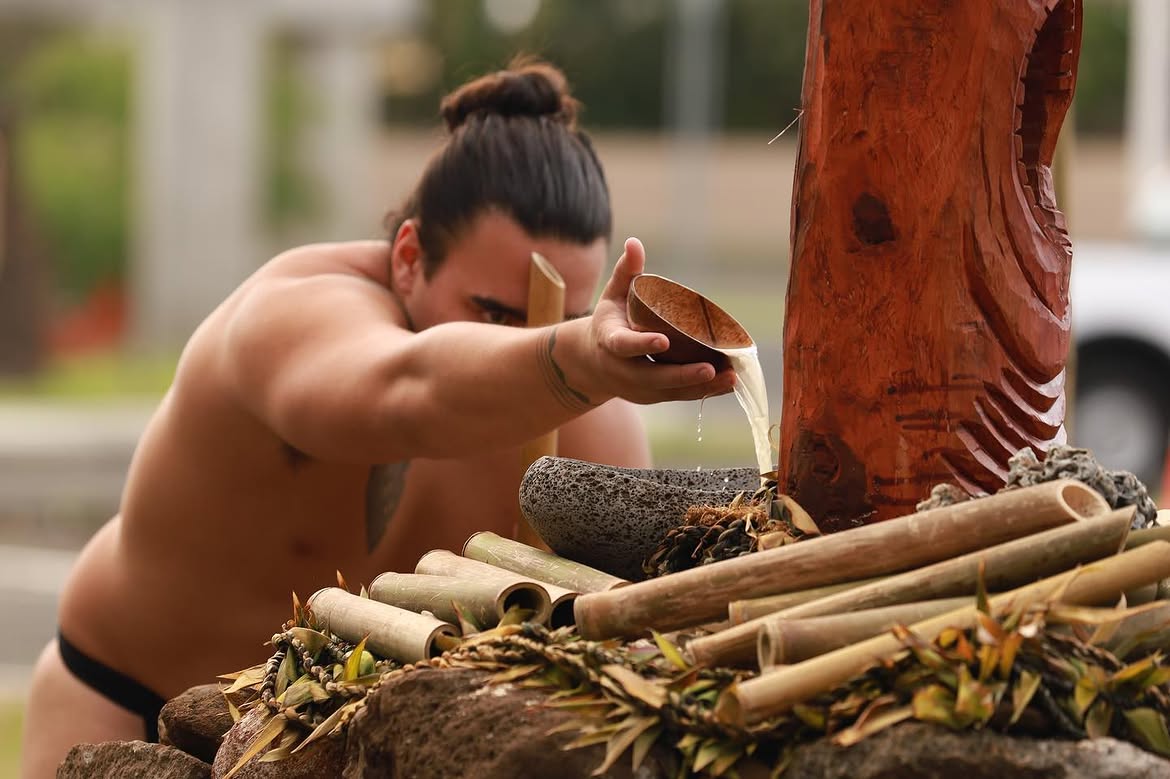
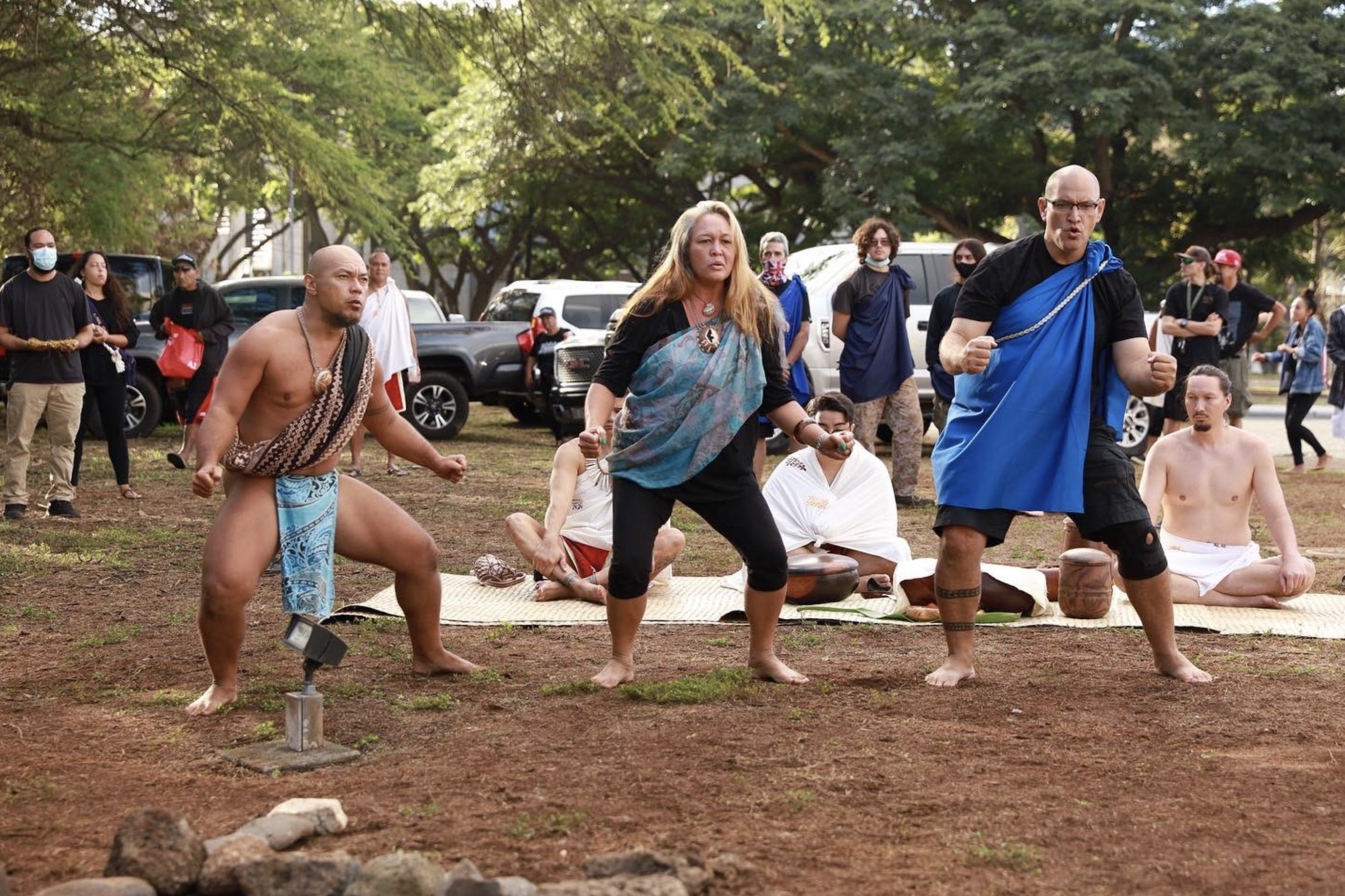
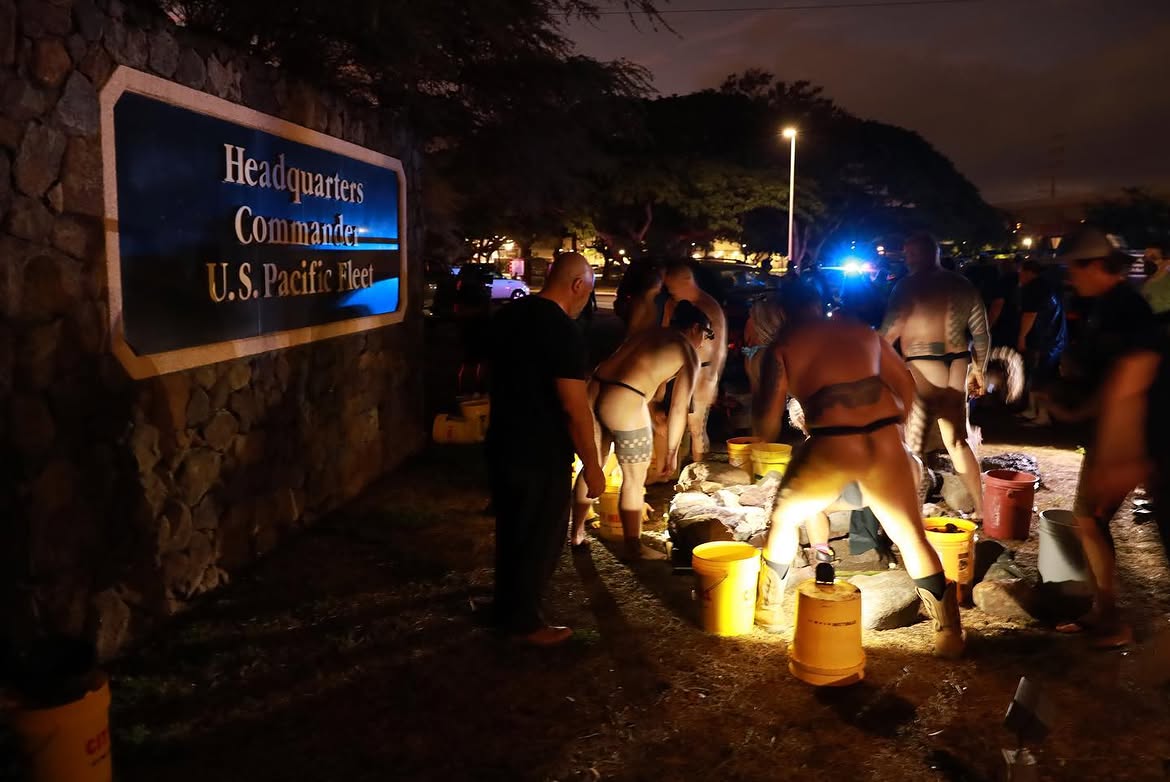
But we also did cultural protocols. We did the kūʻē thing and showed up at Pacific Fleet headquarters and held signs, made offerings. We learned oli, chants, Ka Wai a Kāne. We learned hula. We learned mele, songs about water. We did a lot of cultural practice to connect us to a wide range of people to come together for the protection of this precious resource.
Yessenia Funes: And all that effort resulted in a recent settlement, too. I’m assuming, however, that that victory is not enough, right? No amount of money could replace the water that has been lost or the impact on your health.
Mai Hall: It is a victory that the fuel tanks got shut down, right? It is a good thing that the Navy is working on filtration systems to make the water safe again and has worked with the Environmental Protection Agency to ensure that what they’re doing is correct.
That said, I don’t really trust that the Navy is doing everything they’re supposed to be doing. And there’s no amount of money, like you said, that can ever heal what needs to be healed. My children now have lifelong neurological disorders, and I totally believe it’s because of the water, especially for my son. My son was fine before 2021, and now he’s got different disabilities, including Tourette’s syndrome, which is a neurological disorder with tics and impulsiveness, and is worse than the ADHD that he had previously. The poisoned water worsened some of his symptoms, and he’s now going to have to live with ongoing vocal tics and motor tics for the rest of his life.
Sure, we can use the money from these settlements for supplements and seeing nutritionists and neuropathic doctors to help alleviate some of the symptoms. But in the end, these symptoms are never ever going to go away. So while we won the lawsuit, my children’s health will always be affected. That to me is still a loss. We are still negatively affected by this fuel spill.
Yessenia Funes: There’s also a need to lean into community in these moments, for people to support one another. Talk to me about the role of your community in helping to confront these issues.
Mai Hall: There are a couple of support groups specifically for communities navigating the fallout from this water crisis. People are telling their individual stories, learning from each other, which is how I found out that fuel could affect your nervous system.
But at the end of the day, we just don’t know. We’re all part of this study with the University of Hawaiʻi at Mānoa, the Red Hill Registry. And years down the line, maybe we’ll have some type of data. But for now, we are the control group for this study. They’re studying us, which sucks.
My family’s been super supportive. I remember going to my mom’s apartment and showering in the early days, when they told us not to use the water to cook, bathe, or clean with. I’m lucky as well that my family believed me. When I was crying for a new diagnosis for my son, they didn’t call me crazy. I thought I was losing my mind. But learning that a lot of other mothers out there were making the connection between the fuel spill and this surge in symptoms made me feel a little less crazy. It wasn’t just me. It was all of us.
Yessenia Funes: We are looking at 250 years of this empire. How do you see the Red Hill battle as part of this larger effort to claim Indigenous sovereignty and combat the U.S. imperial machine?
Mai Hall: So this is my opinion, but the military usually comes in, breaks people’s stuff, and leaves. And they feel like they can do that because of individualism.
Hawai’i is collectivist. We think about the whole. But America is very individualistic. The attitude is, What is best for me, myself, and I? I’ve met many Americans and many military Americans who think with that mindset.
I was raised to think about the other, to be collectivist. So when the Navy poisoned its own people, they think, It’s only water; you can get more. It’s only an island; you have other islands. And we’re like, Water is important. Water is sacred. Our island is important. Our land is sacred.
“But I want to be clear: I am not angry at the military. I’m not angry at individual people. I’m angry at the system that they represent, at this attitude of, I don’t care what I do on your land. I can do whatever I want.”
I think the military sees our water and land as a means to an end. I think they see Hawaiʻi as expendable.
But I want to be clear: I am not angry at the military. I’m not angry at individual people. I’m angry at the system that they represent, at this attitude of, I don’t care what I do on your land. I can do whatever I want.
Yessenia Funes: It also speaks to American culture, and the way that we are raised in this country to be very individualistic. But I hear what you’re saying, that it’s not the individual people who are serving the military so much as it is this imperialistic machine.
Mai Hall: And I want to return again to this idea of he aliʻi ka ʻāina, he kauwā ke kanaka: the land is chief, man is its servant. We are inherently tied to our ʻāina, to our land, and it is tied to us. America stole our land and gave it to the military to live on. They made Hawaiians homeless. It’s hewa, it’s bad, it’s traumatizing. They took the land, they poisoned our water, and they’re not facing the consequences of their actions.
But all we want is for them to learn to live with us in harmony and protect what needs to be protected. Give the land back. Learn how to be a good steward. Let me show you how.