
October 2, 2017; Devex and The Hill
Ever since President Trump reinstated the Global Gag Rule blocking funding to any international nonprofits that provide, promote, or counsel on abortions, a global movement to support sexual and reproductive health rights (SRHR) has been gathering steam.
It started with the launch of She Decides, “an international fund to finance access to birth control and abortion in developing countries in order to fill the gap left after President Trump’s gag order,” back in January. This week, advocates gathered in Brussels for a multi-day conference celebrating World Contraception Day, where they discussed strategies to cope with the cuts to health-based NGOs and the United Nations Population Fund.
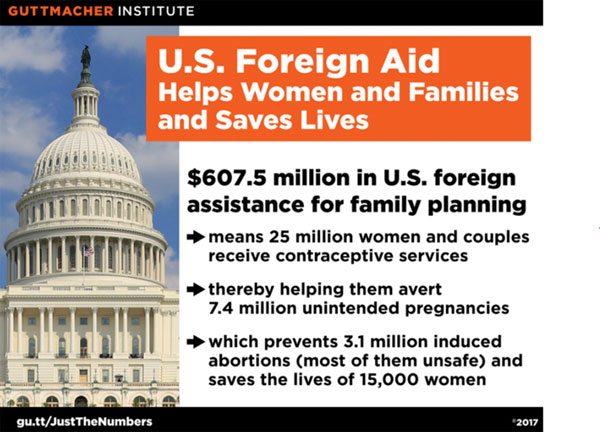
Like NPQ has pointed out several times, NGOs cannot make up the enormous deficit of government funding on a major issue; the US government provides the majority of funding for health-based NGOs, so the gag rule creates an $8 billion gap in global assistance. NGOs at the conference in Brussels came up with five “best practices” to fight for SRHR that should recall debates at many advocacy organizations:
- Don’t let the US set the agenda: Organizations should stay true to their missions despite the effort to impose values upon them from afar.
- How to comply with the global gag rule: Organizations that do choose to comply with the gag rule should try to provide as many services as they can legally justify, staying as close to their missions as they can without losing their funding.
- It’s more complex than “us versus them”: Andrea Peto, professor in the department of gender studies at Central European University in Hungary, points out that creative positioning can help nonprofits avoid making enemies by thinking about what values influence the SRHR conversation in each country. In the political field, says Peto, NGOs can only lose a battle, due to their limited resources compared to governments and political leaders. (Perhaps they should take tips of risky advocacy tactics from Greenpeace.)
- Smarter advocacy: Is it better to take the health approach, the rights approach, or the economics approach? It may vary by argument or by country.
- Toward a more collaborative approach: SRHR is a global issue, and cohesive advocacy stands a better chance of success.
Ulla E. Müller, CEO of EngenderHealth, called for nonprofits to stay true to their missions and not let the current upswing of conservative, nationalist missions override the conversation. “When we start…worrying about our ability to attract funding, we are going down the wrong path,” she said. “When we stay silent, we are gagging ourselves.”
Just to be absolutely clear, access to abortion saves the lives of women all around the globe. It leads to healthier families, more educated women, and more robust economies. In addition to all these things, giving women sovereignty over their bodies is just the right thing to do.
Sign up for our free newsletters
Subscribe to NPQ's newsletters to have our top stories delivered directly to your inbox.
By signing up, you agree to our privacy policy and terms of use, and to receive messages from NPQ and our partners.
While it’s disheartening to see the United States pull back on such a vital global health issue, US nonprofits may soon need to turn their sights inward. On Monday, the Trump administration formally backed a bill banning abortion after 20 weeks, which will come up for a vote in the House on Tuesday and is expected to pass there. According to The Hill, the Office of Management and Budget released a statement saying the administration “‘strongly supports’ the bill and ‘applauds the House of Representatives for continuing its efforts to secure critical pro-life protections.’” Texas tried to pass a similar law last year, after the Supreme Court ruled that its in-state restrictions placed an “undue burden” on women seeking access to abortion.
The Hill predicts that the bill will stumble in the Senate, where it would need 60 votes to pass, but the very nearness of the miss (if it indeed misses) is telling for the public perception of SRHR rights.
Will nimble, mission-driven nonprofits be able to navigate this more troubled health landscape? In other areas where the federal government has fallen short, such as climate change and immigrant protection, state and local governments have picked up the slack in terms of advocacy and commitment to progressive values. With federal restrictions on access and funding, will nonprofits be able to do the same for SRHR?
It’s embarrassing to hear policy specialists tell global gatherings that the US government is failing to promote access to health. It’s frightening to hear a president express support for a bill that imposes such heavy restrictions on women seeking abortions. But it’s reassuring to know that high-level conversations are in the works about how to provide the necessary care to women around the globe.—Erin Rubin