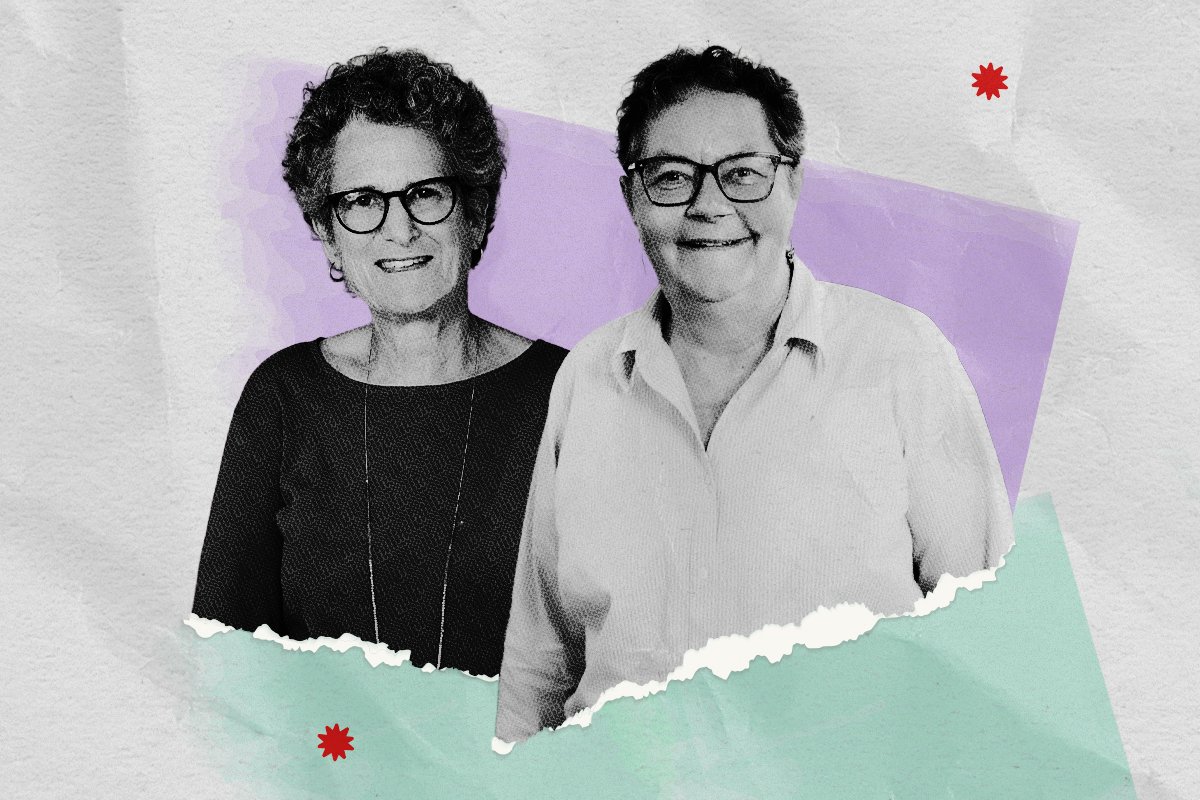
Editor’s note: This letter celebrates the pedagogical legacy of Kim Klein and Stephanie Roth, who helped introduce and uplift the values and discipline of social justice fundraising by supporting everyday people—in the thousands, over decades—to mobilize resources through grassroots fundraising. In the coming months, we will be hearing from a new generation of fundraisers who are finding ways to resource individuals and groups at a time when nonprofit status is under threat and are thinking about a future of wealth reclamation, reparations, and building a new economy.
Dear Kim and Stephanie,
In March 2026, you sent your final newsletter. You announced the end of Klein and Roth Consulting and, with it, the close of a chapter that has shaped how generations of movement fundraisers understand money, power, and the work of building something worth funding.
We read it, and we wanted to honor what your work has meant to so many of us.
In February 1998, Kim, you wrote: “What I really want is to bring a new generation into fundraising for progressive social change.”
You did it. And we are writing to tell you: we are here. We are grateful. And we hope we will make you proud.
We write as two generations shaped by your work. Some of us are newer to this field, we are the next generation Kim was calling for in 1998, finding our footing in movement fundraising and reaching for the frameworks you built. Others have been in this work longer: fundraisers who were themselves formed by your teaching, and who have since gone on to train and mentor the wave that came after them. That thread—from you, through them, to us—is part of the legacy this letter is here to name.
Kim and Stephanie did not do this alone. We want to name those who labored alongside them—especially Nancy Otto, Stan Yogi, and Rona Fernandez—whose work is equally present in what we carry.
The Stories
What I learned from Kim is that most money being given away in the private sector is from individuals, and most of the gifts aren’t coming from rich people. I was able to start an organization because I asked a lot of people to give gifts of any size—and they did. I didn’t have to compromise the mission to fit a single funder’s idea of change, because I could read about what other community-led groups were doing to grow support in the pages of the Grassroots Fundraising Journal. I could engage volunteers in our fundraising efforts because I attended a GIFT [Grassroots Institute for Fundraising Training] conference and could trade notes with colleagues who were doing it too. And, when I was feeling particularly discouraged, I could call Kim and she would answer, giving her time and advice with a generosity I rarely experienced from other leaders.
I have had the pleasure of working closely with Kim, Stephanie, Rona, Nancy, and Stan at different times and for different causes over the years. I’ve benefited from their encouragement, marveled at their creativity, learned from their knowledge, laughed at their jokes, and truly enjoyed each moment of work with them, through every kind of fire, figurative and literal. I am forever grateful for their hard work, wisdom, and generosity.
Aspen Baker
Kim Klein is the reason I continued fundraising for social movements. I got through the most challenging and rewarding five years as a first-time Development Director because I felt seen, heard, affirmed from one one-hour call—likely a call she won’t even remember. A very special shout out goes to Stan Yogi, who helped set up a reliable source of revenue for internships and fellowships through planned giving. As I went on to lead teams during a period of crises after crises, from 2016 through 2024, I did so with a deep commitment to making the connections between fundraising and organizing and to bring others along with me, all of which were inspired by Kim, Stephanie, and the folks who worked closest with them through their firm. Now, all I want to do is give away everything I’ve ever learned, every skill I’ve honed in, fundraising for our movements, as a way to pay it forward and a way to honor the young fundraiser I was in 2008.
angélique nguyễn green, Left Align Consulting
When Kim told a packed room of professional fundraisers something to the effect of: “It’s time we tell board members that instead of ‘our organizations can do more with less,’ we need to say, ‘our organizations are going to do less with less’”—it was a revelation. Their humor, candor, generosity, kindness, care, and all-around love kept so many of us going. And a phrase I still carry: “Effective community organizing is fundraising.” That one line reframed everything for me.
Eric Talbert
When facilitating a training with Kim one time, she made an excellent point that some people prefer to ask strangers over asking people they know. That pushed me to be more creative and flexible with finding volunteers for a role that matches their experiences and interests. And after that training, she sent three things I did well and three things I could improve on. It was so helpful to receive—and now, each time I train with someone, I try to do the same.
They helped me see fundraising as a political act and an act of solidarity—about finding fellow people committed to a particular mission or community outcome and engaging them as they want to be engaged.
The first edition of The Accidental Fundraiser had such a large impact on me that I eventually charmed Stephanie into coauthoring a second edition—and that experience changed how I think about passing on the legacy of grassroots fundraising. So many meetings were spent in her in-law unit office debating whether physical flyers are still used for house parties, whether door-to-door canvassing is something volunteers would do in this age, and whether pre-pandemic walk-a-thons would come back or take new shape. Stephanie has taught me the importance of being thorough and reflective about trainees’ experiences and deepened my commitment to building a base of movement fundraisers who are volunteers. We don’t win without them.
Haley Bash, Donor Organizer Hub
Sending much aloha to Kim for her deep commitment to integrity. I had the pleasure of meeting Kim years ago on Maui when she came to spend the day with our fundraising community. I could not believe our good fortune that the Goddess of fundraising was coming to our island to generously share her experience. Before Kim’s visit, our AFP [Association of Fundraising Professionals] chapter mentioned that she needed a pick-up from the airport. I volunteer a lot—but never have I been so fast to raise my hand. Kim, it was such a treat to meet you and have time together. I wish you many moments of much-deserved joy as you head into retirement. Thank you for touching the lives around you with positivity and for being an inspiration.
Inger Tully
When I took on fundraising at SONG [Southerners on New Ground] as a young organizer, a colleague handed me Fundraising for Social Change and said, “Here, read this book, it knows how to do your job!” I did read that book, and the concepts and tools within, combined with the critical mentorship I was given by my SONG colleagues, helped me develop both the skills and the commitment to be an effective movement fundraiser. In writing that book and bringing its teachings to life, Klein and Roth have gifted our movements a generation of leaders who see the practice of fundraising for social change as our core commitment to movement.
J. F. Lyles, Left Align Consulting
When I graduated from college in 1990, I had thought of fundraising solely as a profession for “polished” people. And I have never been anything close to polished. But then, I met Kim Klein and something shifted. She was funny, quirky, and self-deprecating—in the way that only someone truly knowledgeable and confident in themselves can be. There was nothing performative about it. She was just entirely, disarmingly herself. It was the first time I wanted to call someone a mentor.
I didn’t meet Stephanie until a few years later, and what stayed with me most was watching how they moved together. Kim and Stephanie don’t compete for the same space—they lift each other up by occupying different ones. That’s what real collaboration looks like, and it’s something I’ve tried to carry with me ever since. Because of them, I had an example of what a relationship can look like, where the work we do doesn’t stay at the office. It lives in our relationships, our friendships, our community. It shapes the way we move through the world.
Jackie Kaplan-Perkins
They helped me see fundraising as a political act and an act of solidarity—about finding fellow people committed to a particular mission or community outcome and engaging them as they want to be engaged. By treating fundraising as something we could all learn, if we wanted to, and do together, Kim and Stephanie showed us we could connect with other fundraisers across organizations and movements. It has made me a better board member—one who can model for others that you don’t need to be wealthy to embrace asking and giving.
I still carry something she said that day: “You already know everyone you need to know to raise all the money you need.” That idea cracked something open in me.
I share with everyone I can that the Grassroots Fundraising Journal existed and shaped generations of movement fundraisers—and that the archive now lives on the NPQ platform. Stephanie said it best: “I loved the fact that every two months there was this product that was full of extremely practical information but was infused and informed by social justice values and examples.” That’s exactly what it was. And it still is.
Jeanne Bell, JustOrg Design
As a new fundraiser, a few months into the job, the founder of my organization passed away. Panicking and looking for help, I called Stephanie, and she took my call. She gave me a bunch of great ideas for using the memorial as a fundraiser for the cause. I realized that I wasn’t alone in this work.
One of the first things I did as a new fundraiser was go to the GIFT conference. I realized there that I was not alone, and that all of us in some way owed what we did to Kim and Stephanie. A phrase I’ve carried ever since: “Givers give.” It encourages me to ask, and it encourages me to be a giver as well. The most memorable fundraising training I’ve ever taken was a train-the-trainer session with Kim. So many gems—and the feeling of being taught by the best. Now I try to be the best I can be when I train others.
Jeff Pinzino
As the board chair of our organization, Kim Klein modeled holding a strong line in relation to integrity, values, money, and power. Her humorous and direct approach meant we worked through difficulties with transparency and laughter—a great combination for getting things done and not taking it, the work and oneself, too seriously. I’ve also witnessed a fierce side to Kim: she fights for justice and what is right, like a mama bear protecting her cubs. Kim’s impact is so large that it is immeasurable and will be felt around the world for generations.
Kamala Tully, Mesa Refuge
I will never forget attending my first Kim Klein fundraising training at a CTWO [Center for Third World Organizing] organizer training at Blue Mountain Center in 1985. It changed my life by setting me on a path to become a successful movement fundraiser and trainer. Whenever I do a fundraising training, I describe myself as “a disciple of Kim.” Favorite lessons I repeat to this day: “Success is in the asking.”
“Babe Ruth is remembered today for being the Home Run King, not the Strike Out King—he knew he had a chance to hit a home run only if he took a swing, and wasn’t afraid to strike out.”
“Giving money to a cause they believe in makes people feel good about themselves. The more they give, the better they’re gonna feel.”
“If you haven’t raised any money today, you haven’t asked enough people.”
“Replacing metaphors of violence in how we talk about the fundraising process, with metaphors of love, advances the kind of world we seek to create.”
And the one that has stayed with me longest, perhaps because it is the most quietly radical: “Sometimes the most important thing to do is to make the coffee.”
Mark Toney, TURN [The Utility Reform Network]
Sign up for our free newsletters
Subscribe to NPQ's newsletters to have our top stories delivered directly to your inbox.
By signing up, you agree to our privacy policy and terms of use, and to receive messages from NPQ and our partners.
In 1977 I got a good-sized grant, hired two people, and started the St. Louis Economic Conversion Project to track McDonnell Douglas military spending in St. Louis. In 1978 I needed money. Kim said, “Why don’t you become a member organization?” We did. Eventually we changed our name to the Peace Economy Project, and we are still out there, depending on our members, doing the work.
It’s the simplest thing. Ask. Discomfort in asking is cross-cultural. Everyone appreciates being asked.
Mary Ann McGivern, Loretto Community
Attending the GIFT conference in 2014, 2016, and 2018, changed my professional life. Not only did I find the experience motivating, inspiring, and tactically helpful—it was just great to be in the same physical space as so many movement fundraisers. Our firm’s conference, Stories + Money = Change, is very much inspired by the GIFT conference.
Mary Grace Wolf, Innovative Fundraising
I remember going to a fundraising training led by Kim Klein and being completely blown away. She was smart, savvy, and big-hearted—and she made me want to become a fundraiser. I still carry something she said that day: “You already know everyone you need to know to raise all the money you need.” That idea cracked something open in me.
I also remember applying for a job to work with Kim and Stephanie as an admin assistant—it came down to staying in the Bay or moving to Seattle. I ended up moving to Seattle, but passing on that job was one of the hardest decisions I made in my twenties. I respected them so much and knew I would learn enormously just from being in their orbit.
But what I’ve learned most from Stephanie and Kim is that it is up to us to build what we want to see.
Attending a GIFT conference and reading the GIFT journals felt like finding my people. The conversations held both the nuts and bolts and the big-picture values—I was in love.
Kim and Stephanie will always be my sheroes and mentors in this work, even though we only spoke a handful of times. They showed me it was possible to be a total fundraising nerd and have a huge impact on the world. And I loved that they were this powerhouse lesbian couple teaching everyone what it means to transform our relationship to money.
Thank you.
Michael Gast, Organize the Rich
Fundraising is political organizing and vice versa. The needs we are fundraising for cannot be separated from the fundraising work itself.
Kim’s mentor Hank Rosso said it best, and Kim has passed it on to all of us: “Kick yourself out of the way and let your cause speak.” You can get over the fear of asking. There are ways to be a successful asker, and Kim laid them out for us—in Fundraising for Social Change, and in her seminal Grassroots Fundraising Journal article, “Getting Over the Fear of Asking.”
What I’ve carried most into my work is this: people want to be helpful. They want to join a cause they believe in. It’s our job to give them the opportunity to do so. Giving is itself an act of social change. Enabling people to make those gifts brings them into the struggle. Embrace fundraising as a central part of the work—not something we do in order to get the work done, but part and parcel of the change we are working for.
Myn Nancy Adess
I am forever grateful for the generosity, kindness, tough love, insight, feistiness, wisdom, tears, and laughter you have shared with me over two decades. I have been forever changed because of you.
Nancy Otto, Klein and Roth Consulting
I used to think fundraising was candy sales and writing grants and the goal was to get the money to do the program. Then GIFT taught me that grassroots fundraising is actually about building power and building relationships, and that completely changed my world. I am still fundraising 25 years later because of that.
But what I’ve learned most from Stephanie and Kim is that it is up to us to build what we want to see. There aren’t fundraising resources for grassroots activists? We’ll make them. There isn’t money for this issue? We’ll help you find it. There aren’t programs for people of color to become fundraisers? We’ll create them. There aren’t national gatherings for social justice fundraisers? We’ll start them. They democratized the field of fundraising, making it possible for people like me to feel like I belonged, and paved the way for us to continue building and visioning.
Priscilla Hung
I’ll never forget my first-ever training with the Grassroots Institute for Fundraising Training (GIFT) held at the CTWO mansion in Oakland, CA. Although I had been a student activist and organizer, I never thought of fundraising in the context of movement-building until that weekend. I met Kim and Stephanie for the first time, along with other leaders in the work who shaped my professional journey in profound and lasting ways. Our bible was and is Kim Klein’s book Fundraising for Social Change.
My entire career in the nonprofit sector, and beyond, is shaped by Kim, Stephanie, GIFT, and the Grassroots Fundraising Journal. Twenty-five years later, the lessons I learned continue to be applied in my work on a daily basis. The most fundamental is the role and importance of relationship-building—it’s relationships that are the core and abiding goodness of social change work. I still give copies of Fundraising for Social Change to any new fundraisers: although strategies, technology, and trends change, the principles of fundraising remain the same.
Sonya Garcia Ulibarri, GIFT Intern, Class of 2000
I learned from you, Stephanie and Kim, that fundraising is a form of community organizing that can empower people to manifest their deepest values. You taught me that by not talking about money—by not asking people to donate to organizations whose missions they find compelling—we’re buckling to oppressive systems and taking choices away from folks who can contribute, financially and otherwise, to their own liberation. And one phrase I’ve passed on more than any other: “Thank before you bank.” Because donors want to feel appreciated.
Stan Yogi
Many of us approach this work now with a clarity you helped us find: that fundraising from the people—from thousands of small donors who have skin in the game—is itself a democratic act.
I remember when Kim and Gary Delgado engaged in a public debate at one of the grassroots fundraising conferences about individual donor development versus foundation fundraising. It was like heavyweight contenders entering the ring—the biggest match of the century for the community organizing world. Kim argued for and held the line on the power of individual fundraising; Gary took a stance in support of raising big dollars from foundations. I remember cheering, silently, for Kim—describing how any organization, regardless of size, can raise funds through grassroots fundraising, how it develops leaders, builds power, and isn’t dependent on the whims of foundation trustees. She brought humor and clarity to her argument. And while I know it’s not about choosing one over the other, I really appreciated the steady, patient work of base-building and grassroots fundraising that is required for our movements to grow.
Stacy Kono
I have known Kim and Stephanie since even before I started calling myself a fundraiser. I met them through CTWO because GIFT used to have an office in the attic of the old mansion (the good old days!). But even before that, I had already benefited from their training of movement folks when I worked with Californians for Justice, where I learned to ask for $1 with EVERY organizing ask I made on the doors and in the streets. From the start of my career in organizing, fundraising was NOT an optional thing but an integral part of engaging people in the movement. This is the orientation that Kim and Stephanie have been so consistent about for so long, and what we all should permanently etch into our ‘raps’: that organizing and fundraising are inherently connected. The best organizers and movement fundraisers know and live this. I am so fortunate to have been trained by and to have worked with Kim and Stephanie. Thank you for all you’ve given to me and the movement. Relax well now, knowing that you helped create a whole generation of folks who will keep organizing + fundraising at the center of our work.
Rona Fernandez, Asian Pacific Environmental Network, long-time Klein & Roth, Consulting Senior Consultant, Development Director, movement fundraiser
Kim Klein was my Rabbi of movement fundraising, and her teachings and methods were my Torah for fundraising for social justice. She is Christian, and I am Jewish, but we are both deep believers, and I love discussing our shared faith and its impact on our work with her. I owe my approach to this work and joy to her. I can’t march anymore, but I can fundraise and always sign up for the fundraising committee! I saved all the early Grassroots Fundraising Journals and all of Kim’s and Stephanie’s books and refer to them repeatedly. My joy in raising money for issues I care about and eliciting that joy in the people I work with stems from working with both. Stephanie and I did more direct work together in reproductive rights and anti-rape organizing and learned how to lead together, disagree without losing our mutual respect and love for each other, and always find a way forward. I learn so much from her! I love them both, respect and admire them. Fundraising friends and comrades forever!
Marjorie Fine, Philanthropic Consultant
Fundraising often feels thankless. The workload is unrelenting, and your comrades are often disdainful. Meeting Kim and Stephanie, learning about GIFT and the Journal, and connecting with their community was a huge turning point. Getting to know them helped me claim my identity as a social justice fundraiser. Both of them have such integrity and clarity about their values. Also, they are FUN! Their humor, joy, and zesty personalities made me feel like it was okay to be me and to love fundraising. And I think they should get a Gold Medal, a Congressional Medal of Honor, a Nobel Prize, and an Oscar.
Dolores Garay
The Promise
What was built did not stay in one place. It moved—through workshops and dog-eared books and late-night conversations, through the fundraisers who learned from you and then turned around and taught someone else. The stories above are proof of that movement. They are not a complete accounting. They are a sample of what this work made possible.
Many of us approach this work now with a clarity you helped us find: that fundraising from the people—from thousands of small donors who have skin in the game—is itself a democratic act. Every time we build a broad base of givers rather than cede our direction to the wealthy few, we are reclaiming power. In a moment when that power feels more fragile and more essential than ever, we carry your teaching as both strategy and conviction: grassroots fundraising is not a workaround. It is the work.
The current moment demands everything you taught us. As our movements face crisis and pressure, we return again and again to the questions you asked: Who is funding this work? Who could be? What does it mean to build power through fundraising, not just sustain it? We don’t always have the answers. But we know how to ask the questions because of you.
We carry this forward. Into harder times, new contexts, and the next generation of fundraisers that we are already beginning to shape. The work continues. The legacy lives.
With profound gratitude, solidarity, and love.
Signatories
- Aspen Baker*
- angélique nguyễn green*
- Eric Talbert
- Haley Bash*
- Inger Tully
- F. Lyles*
- Jackie Kaplan-Perkins
- Jeanne Bell
- Jeff Pinzino
- Kamala Tully
- Mark Toney
- Mary Ann McGivern
- Mary Grace Wolf
- Michael Gast
- Myn Nancy Adess
- Nancy Otto
- Priscilla Hung*
- Sonya Garcia Ulibarri
- Stan Yogi
- Stacy Kono
- Steve Lew*
*Organizers