Make America kind again.
Although I have lived through 15 presidential elections, the past decade has been the saddest time for me—and for others around the globe who regret the dwindling of compassion in American politics and the Trump administration’s attempts to weaken the human solidarity that empathy makes possible.
We had plausible reasons to despair: Donald Trump’s second election, and his trifecta win securing both chambers of congress, his aim of making good government smaller and billionaires richer, along with the harmful actions that followed. The decline in the economy, the continuing stagnation of wages, and the deportations deepened the isolation of the COVID years. Formerly protected immigrants were threatened, additionally isolated by political angst and personal anxieties. Many people were walled off—disconnected from empathy and human connection.
Harsh attitudes towards others were expressed by Trump and the rebarbative Elon Musk, among others. The so-called Department of Government Efficiency (DOGE) cuts in beneficial government programs injured millions. Trump vilified immigrants by national origin—Latinx, Somalis, Venezuelans—in a campaign whose virulence and cruelty resulted in imprisoning them with the Supreme Court’s approval. The attacks on diversity, equity, and inclusion left many feeling that their staunch and effective work on civil rights was being undone. After all, it was Musk who said that empathy was a “fundamental weakness of Western civilization.” It must be fundamental indeed, as all the Abrahamic religions and Eastern faiths endorse it.
Compassion Personified
One nadir of our national malaise was marked in a historic speech only three months after Donald Trump’s second inauguration. In 2025, from 7 pm ET on March 31 through the evening of April 1, Senator Cory Booker of New Jersey delivered a marathon oration on the Senate floor. He stood, speaking only with notes, without eating or leaving the space, for twenty-five hours and five minutes—with one overriding goal: “That’s the key here…to deal with the poverty of empathy we have in our nation right now.”
Senator Booker exhorted us to expand empathy beyond “feeling” and “caring.” He continued, “I think the poverty that most worries me is the poverty of empathy, the poverty of compassion, because you need that to do something else”—the something else being, actions. Millions watched some parts of the speech. The speech topped 350,000,000 likes on TikTok live. Booker, channeling John Lewis, called for people of conscience to go out and cause “good trouble.”
It seemed impossible that one exhortation, however plangent and historic, could defeat the lies relentlessly promoting racism and xenophobia that kept us divided, silent, and numb.
Months after Senator Booker’s speech, however, on June 14, 2025, the first of the No Kings! protests, also known internationally as the No Dictators or No Tyrants protests, took place. The series of political demonstrations in the United States made visible our protests in favor of democracy, the rule of law, DEI, and internationalism—and against the authoritarian policies and fascist utterances of Trump.
Since then, an explosion of solidarity has brought hundreds of thousands of citizens into the streets, protesting the brutal tactics of masked men in unmarked cars, the harassment of people of color, and the cruel kidnappings and deportations of people with no criminal records. It is the dangers others face from the ICE raids in American cities that led directly to daily and weekly actions. For weeks, months, and now over a year—growing stronger all the time.
People of apparent privilege, because they are citizens, or look White, have been using their seemingly ostensible forms of immunity to protest. Even ICE’s crude murders of two young White people, Renee Good and Alex Pretti, did not deter them. People of all ages appeared in increasing numbers.
They came outside in the cold and the heat to speak on behalf of those who were justifiably fearful. In Minneapolis, volunteers unlikely to be stopped brought food to families who didn’t dare go out to shop. Volunteers took their children to school. Organizations provided help with paying bills for people who couldn’t go out to work.
A year ago, we thought the deficit of empathy could only grow in these grim times. But good people marched, and they also composed an entire private welfare system.
The Age of Protest
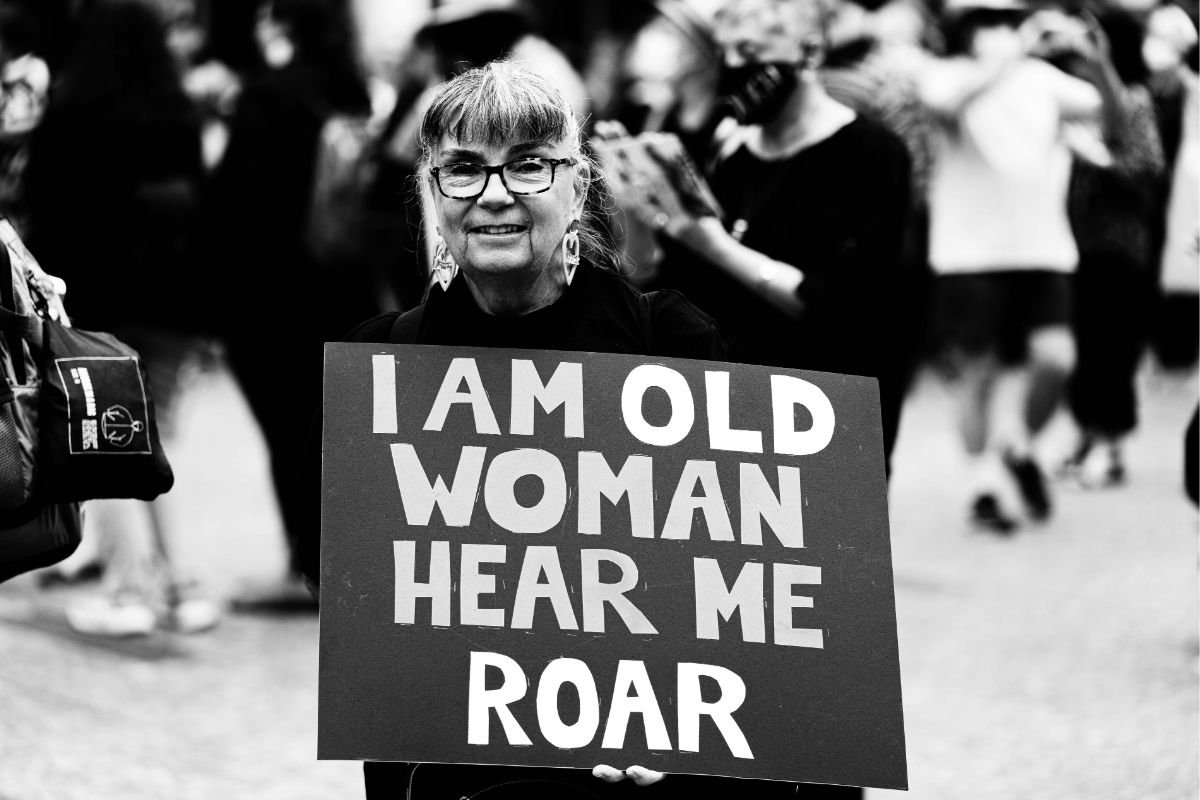
Older adults have been noticeably in the fore in many public events, carrying a raft of imaginative signs, ringing bells, singing and shouting, “ICE Out.” I, too, notice a lot of grey and white hair.
I appreciate seeing people close to my age: I have just turned 85. I’ve seen couples with one sitting in a wheelchair, one pushing. I met one retired couple on a bridge brigade in New Bedford, MA; they join weekly even though they are soon moving to Canada as new citizens.
Sign up for our free newsletters
Subscribe to NPQ's newsletters to have our top stories delivered directly to your inbox.
By signing up, you agree to our privacy policy and terms of use, and to receive messages from NPQ and our partners.
I encounter people I know in gatherings throughout Massachusetts. A couple in their seventies: he carries a hand-made sign, “Basta con el miedo.” (Enough with the fear.) Women I have chatted and signed postcards with, in a Cambridge church hall. A retired woman Radcliffe College administrator, in a Waltham No Kings! Day protest. A retired woman professor from my university, both of us in front of the Burlington, MA, ICE detention center. The professor was right ahead of me, among a line of people waiting to read the Declaration of Independence and the Bill of Rights into a mic in front of the building. I asked to read the Fifth Amendment in Spanish, La Quinta Enmienda, the one that guarantees due process.
Why are these events disproportionately attended by older adults?
According to social psychologists from Berkeley and Stanford, growing older leads to “increased emotional empathy and prosocial behavior.” We are of an age to be moved by situations of suffering, signaling the need for help or reparation; we tend to “shift away from self- and future-oriented goals to social and emotionally meaningful ones.” Consciously or not, many of us become more generative in later life, as Eric Erikson suggested we should, in The Life Cycle Completed: A Review. Warmth and concern combine with distress at the grief of others.
I also notice more women than men of this age. Women allegedly have more empathy, starting in infancy. Women may develop it through the daily practices of raising children. “Maternal thinking” (described in my late friend Sara Ruddick’s homonymous book, from 1980) survives deep into the post-maternal period.
Too few articles focus on political action, but feminist activism positively influences women as they grow older, Anne Barrett et al argue in the Journal of Women & Aging. Activism in public counters “the cultural devaluation of older adults” and confirms “personal growth and sense of purpose” that may otherwise be lost to ageism in later life. Certainly, we are not invisible, not irrelevant, as we stand on highways waving our satirical signs on all topics. The Raging Grannies are out from coast to coast, singing original satirical songs.
Many older women and men I know in the United States add a personal, historical dimension to gendered and age-graded psychological explanations for the age of protest. My sign reads “Make America Kind Again.” Some retort, not meanly, “Uh, when was that!” We have piercingly lived through progressive phases, painful government failures; backlashes. Younger people learn that history, if they do, from books. And now, from us.
“We are veterans of protest movements,” a friend who is 77, formerly a teacher and high-school administrator, instantly tells me. “The lessons learned [from helping to end the Vietnam War] spilled over into the civil rights movements, women’s rights movement, the environment, nuclear disarmament and the peace movement, fighting for better schools for urban students, and today, protesting the war in Gaza…”
People around our ages—often disparagingly called “the Silent Generation” or “Baby Boomers” –when young, in fact, joined one movement after another. Telling “personal narratives of political journeys,” as Lynne Segal urges us to do in her own narrative, Making Trouble, is valuable. “Older radicals and younger rebels have equal need of such history.”
If the younger adults notice the color of our hair and our walkers, I hope that promotes to them a higher valuation of later life. We also show the youths (and the media) the persistence of the impulse to resist. As we started, so we continue. This is what a good old age looks like.
I know everyone around me feels a sense of purpose in combatting toxic Trumpism, even if we add just one face to the mosaic of opposition. We all call the goal, the motive, and the habit of activism, “social justice.” Whoever protests started out with a deeply felt need to live freely in a more equitable and peaceful America.
Solidarity for a Peaceful America
As we struggle on despite ICE violence and inhumane incitements to hatred, non-violent resistance continues on many fronts. Empathy and the need to fight our anxiety about the state of the nation in concert with others, lead us to constitutionally protected actions. Everywhere there are rallies outside detention centers, everywhere there are poster-waving groups standing along cross-streets or on bridges; everywhere, spreading, there are plans for other protests. People are starting the pro-social post-carding get-togethers that may swing the 2026 and the 2028 elections.
The Resistance has already succeeded in significant ways in showing that deep down millions care about the most vulnerable.
Collective protests are ethically valuable, encouraging to immigrants and energizing to participants. But the United States needs to get back officially sponsored compassion—government programs that make America kind again. I think of programs that could be restored or expanded to help older adults at most risk of hunger or negligence or even death: Meals on Wheels. Homecare, which keeps people out of institutions. Medical parole for people on long sentences in prisons who are dying in dreadful conditions. The most vulnerable in COVID, and now, are the residents of nursing facilities, who continue to die whenever private equity takes over a “home.” They need Biden’s historic reform: a minimum requirement of hours of care per person per day.
Meanwhile, a healthy part of us remains strong and brave. Solidarity is again a trait that “we the people” manifest.