
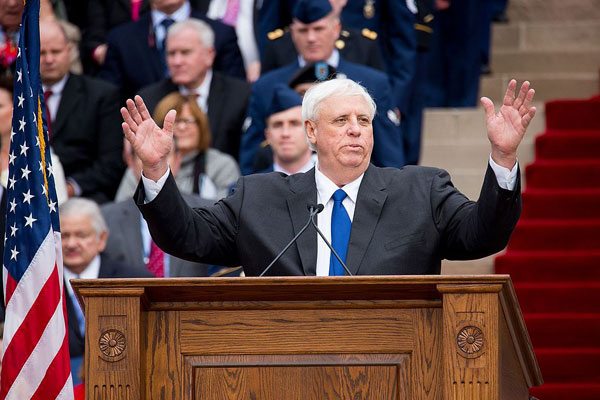
West Virginia Governor Jim Justice attended a Donald Trump campaign rally in Huntington, West Virginia last night to announce his decision to the president and 9,000 rally attendees that he will switch his party registration to Republican on Friday (video here). Should we be surprised?
NPQ has reported on Jim Justice previously as a man known as a showy philanthropist who doesn’t necessarily pay out the money that he pledges. One of those pledges was to the Boy Scouts. He is known for cutting corners on his business dealings as well. Perhaps this sounds eerily familiar to you; NPQ commented on the similarity between Justice and Trump in October 2016:
According to this report, dozens of Justice’s mines, across West Virginia and other Appalachian states, have a history of safety violations and late payment of the penalties that are supposed to discourage unsafe practices. But since its last investigation in 2014, NPR has found that the mines owned by Justice have worse than average safety records, with injury rates at twice the national average and violations at four times the national average, and they have garnered another $1.38 million in new and unpaid mine safety penalties.
Even as they were delinquent in paying past penalties, Justice’s mines were cited for 3,657 violations, 699 of them classified by the Mine Safety and Health Association as factors in mine fatalities and major disasters. There are, unfortunately, no effective enforcement policies to make mines pay what they owe in safety fines, though a bill now in Congress would give the agency authority to shut down mines that have been delinquent for six months or more.
Justice, however, seems to be in political territory we are all having to live with lately: the denial of the patently obvious when it comes to personal responsibility.
“I’m a safety fanatic,” he said at a news conference. “So I’m the last person in the world that’s wanting something to where you would put an employee in a situation that would be unsafe.”
And if that were not enough, Justice has brought his deadbeat tendencies to his philanthropy, too. In 2011, and to a lot of fanfare, Justice pledged to contribute $10 million to Cleveland Clinic Innovations. But a Cleveland Clinic spokesperson, Janice Guhl, told NPR that “no money was received from Mr. Justice.” Similarly, Justice has paid only $5 million on a $25 million pledge that was intended to create the James C. Justice National Scout Camp in West Virginia.
But this is not where the similarity ends. The 66-year-old billionaire was elected as a Democrat last November in his first run for public office. Referring to a frustrating 2017 state legislative session, Justice said “The Democrats walked away from me,” when, Justice claims, legislators and the governor were “at the altar” on a deal before it fell through.
There was some greatness passed…but there was way too much pain. We hurt a lot of people—our vets, our teachers, our disabled, and our weak, and we walked away from the old.
Sign up for our free newsletters
Subscribe to NPQ's newsletters to have our top stories delivered directly to your inbox.
By signing up, you agree to our privacy policy and terms of use, and to receive messages from NPQ and our partners.
I can’t help you anymore as a Democrat governor.
Justice ended his statement with predictable praise for Trump, including condemnation of the investigations into collusion with Russia and, noting the recent departure of Reince Priebus, said that the country once again has a chief of staff with a first name we can pronounce. Resuming his speech after Justice’s remarks, Trump referred to Justice as “Big Jim.”
With Justice’s decision, Republicans now control 35 governorships in the U.S., compared to 15 for Democrats. But should Democrats be sorry to lose Jim Justice?
At the time of his election, Justice owned more than 50 corporations and businesses, including the Greenbrier luxury resort and a hunting and fishing preserve. Justice’s Bluestone Farms owns 50,000 acres of cropland and is one of the largest grain producers on the east coast of the U.S. However, Justice is best known for his ownership of his family’s coal mines and, as NPQ’s Rick Cohen reported in 2014 in an article entitled “Philanthropist Coal Mine Owner Refuses to Pay $2M in Health/Safety Fines,” he has a poor safety record and arguably worse success at paying federally imposed fines associated with mine safety violations. Cohen wrote:
At the same time as Justice is dispensing charitable gifts and purportedly public-spirited corporate investments, he is also a scofflaw, owing more than $2 million to the government in mine safety violations. According to Berkes, Justice has “five hundred penalties…overdue, four times as many as any other delinquent mine owner.” As a billionaire, Justice ought to be able to pay up, but he hasn’t. According to Congressman George Miller (D-CA), Justice is “certainly exhibit A of the kind of operator that should not be allowed to continue with reckless disregard of the law.” A Justice representative said that Justice has actually already paid $500,000—which, if true, would make the unpaid bill only $1.5 million—and that operating costs at the mines have cut profit margins and made payment of safety fines a challenge.
Justice’s companies had paid $675,000 in overdue federal fines in 2016 as he was running for governor, but there was no specific timetable announced for completing all payments. In 2016, Justice and his companies owed $15 million in fines to six states and the federal government.
As we said above, Justice’s philanthropy raises questions just as his business stewardship does. Relatively few people know that last month’s international Boy Scout Jamboree was held at the James C. Justice National Scout Camp, a part of West Virginia’s Summit Bechtel Reserve named for Justice’s father. Justice had pledged $25 million for the project, but apparently stopped giving after donating $5 million and the land for the camp bearing his father’s name. Neither Justice nor the Boy Scouts of America (BSA) would comment specifically on whether Justice’s pledge had been honored in full. Justice used $450,000 in state funds at the governor’s discretion to finance community service activities performed by Scouts during last month’s Jamboree.
Politically speaking, losing a governor to the opposing party is always a blow. Given the bizarre nature of politics since the 2016 campaign and through the first six months of the Trump presidency, a variety of narratives present themselves for consideration. Justice and Trump have known each other for several years and have had a good relationship as business owners and wealthy men. Justice won the 2016 Democratic gubernatorial primary easily and the general election by almost seven percentage points, defeating the GOP’s candidate, state senate president Bill Cole. Personal relationships and electoral calculus both could have figured into Justice’s decision. Trump’s White House can support Justice’s West Virginia on important issues from economic development and employment to energy and the state’s opioid addiction epidemic, among the worst in the nation.
Justice’s switch weakens the state’s Democratic Party and casts a shadow on the 2018 re-election prospects of first-term U.S. Sen. Joe Manchin. Manchin is a moderate and a Democrat in a state that went for Trump in a 68.5 to 26.4 percent landslide, carrying all the state’s counties in 2016. Even with Trump’s weakening popularity since taking office, Justice’s party switch, announced on stage with the president, sends a strong signal to Manchin, voters, and donors inside and outside the state that at least some West Virginia political leaders are still willing to bet big on Trump and the Republican Party.